

In 2024, seven in ten workers reported that they had experienced disruptive change in their workplace. From managers to team members, high percentages indicated that the transformations in their workplace were extensively disruptive, making them far less willing to support change in the future. Not all organizations successfully manage change—as is evident from this reporting. This is becoming a serious problem as more and more organizations operate in a mode of continuous transformation.
For any business transformation to succeed, things must change. If leaders want employees and other stakeholders to embrace the change and put in sustained effort, they must understand where the organization is going and how they fit into the journey—that is, they must define goals and set a path to get there. This is the essence of the transformation blueprint approach to change management.
At Shibumi, we’ve partnered with hundreds of organizations to facilitate their transformation journeys. As such, we know that setting the right goals and milestones—goals that motivate employees to get behind the effort and expend their energy—is undeniably one of the most critical parts of any transformation journey. That’s why we’ve decided to share our best thinking on how to create sustainable, meaningful change.
What Is a Transformation Blueprint?
A transformation blueprint is a detailed roadmap for strategic change. It documents the organization’s current state and its desired future state, outlining every step of the way to get there. The transformation blueprint isn’t just a step-by-step plan; it also includes resources, timelines, and KPIs that will indicate progress and success. This singular document has the power to align entire teams around organizational shifts.
Some key components of a transformation blueprint include:
- The current state of the organization: The existing processes, challenges, and capabilities of the business.
- Vision and goals: This section defines what the organization hopes to achieve through transformation and why change is important. This includes the future state of the business—the new processes, structures, and technologies that will be implemented.
- Roadmap: Breaks down the overarching goals into actionable projects, milestones, and dependencies. This includes the implementation plan broken down phase-by-phase (assessment, design, implementation, evaluation).
- Resource allocation: The required talent, budget, and technology to get the job done.
- Key metrics and governance: This section establishes KPIs, metrics, monitoring methods, and who is responsible for tracking them.
- Change management strategies: General plans for cultural shifts, communication, workplace education, and stakeholder engagement.
The benefits of a defined, robust transformation blueprint are many. They provide clarity, ensure alignment, manage complexity, and help ensure that the best possible outcomes are achieved.
Getting Started: Prioritize Initiatives Based on Benefits
As Shibumi studied transformation programs, we noticed some common pitfalls. Many businesses tend to get stuck in one particular area: Company leaders often can’t agree on which specific initiatives to prioritize implementing. Other common frustrations around transformation include a lack of roadmap visibility, inefficient allocation of resources, lack of adequate coordination between teams, project delays, and cost overruns.
These issues don’t just decrease productivity. They also degrade employee morale—which ultimately reduces the potential benefits of the transformation. While each of those pitfalls is distinct, they share a common solution: They could all be solved (or at least mitigated) if the organization consistently prioritized the right initiatives.
So, how do you correctly prioritize your initiatives? The key is to ground your decisions in terms of benefits. While this is an art more than a science, we typically see organizations evaluating their initiatives through four benefit categories:
- Alignment: Is what we are doing clearly moving the needle on company-wide priorities? Each organization must prioritize certain goals over others within a given timeframe.
- Financial value: Can we clearly measure the financial benefits (e.g., revenue, costs) to determine ROI? Profitability is the lifeblood of any company. Regardless of duration, each idea and initiative must be meticulously assessed for its potential to contribute to the company’s profitability, safeguarding its financial health and sustainability.
- External benefits: What is the impact on stakeholders outside the company, like customers, investors, etc.? Initiatives aimed at enhancing the company’s reputation and market position are crucial. They are designed to attract and retain customers, build brand loyalty, and foster trust.
- Internal benefits: Will this strengthen our relationship with employees and enhance our culture? Initiatives that aim to develop talent, upskill employees, and improve culture will help an organization attract and retain top talent and foster loyalty, which in turn lowers hiring costs and positions the organization to build better products and deliver amazing customer experiences.
By assessing benefits through these four categories, organizations will get a clearer sense of what matters most to them. These categories should be weighted according to your business priorities and needs.
How to Forecast and Quantify the Financial Value of Initiatives
Determining the financial value of initiatives may be simple or quite involved. If you’re unsure of how to get a solid forecast of financial value, start with the techniques below:
- Gather information: Gather information through market research, competitive analysis, customer feedback, and internal cost/resource data sources.
- Do a cost estimation: Estimate both the initial and ongoing costs associated with the initiative. This includes direct costs (e.g. technology, labor, materials) and indirect costs (e.g., training, overhead, maintenance).
- Project revenue and cost savings: Consider different revenue streams, pricing models, and sales forecasts, as well as the potential cost reductions that might be accessed through streamlined processes, resource optimization, or other efficiency measures.
- Payback period: Determine the time it takes to recoup the initial investments through the net cash flows or hard-dollar savings generated by the initiatives. Run the calculation to determine the anticipated net benefits over the required time horizon.
- Risk assessment: Identify potential risks and uncertainties that could impact the financial outcomes of the initiatives (resources, customer adoption, etc.). Assess the likelihood and potential impact of these risks.
- Conduct a sensitivity analysis: Evaluate how changes in key variables or assumptions impact financial outcomes, helping to identify the initiatives’ sensitivity to different scenarios (e.g. a change in demand).
How to Define Success Criteria for Key Initiatives
Once you’ve identified your objectives and key initiatives, it’s time to define specific success criteria for your key initiatives.
The specific, relevant indicators will vary based on the type of initiative you’re implementing and the key stakeholders/topics you want to influence. For example, good success measures for initiatives that aim to improve customer experience with your software may include customer satisfaction, retention, net promoter score, and loyalty. On the other hand, a sustainability initiative’s success might be judged based on measures like reductions in CO2 emissions or waste.
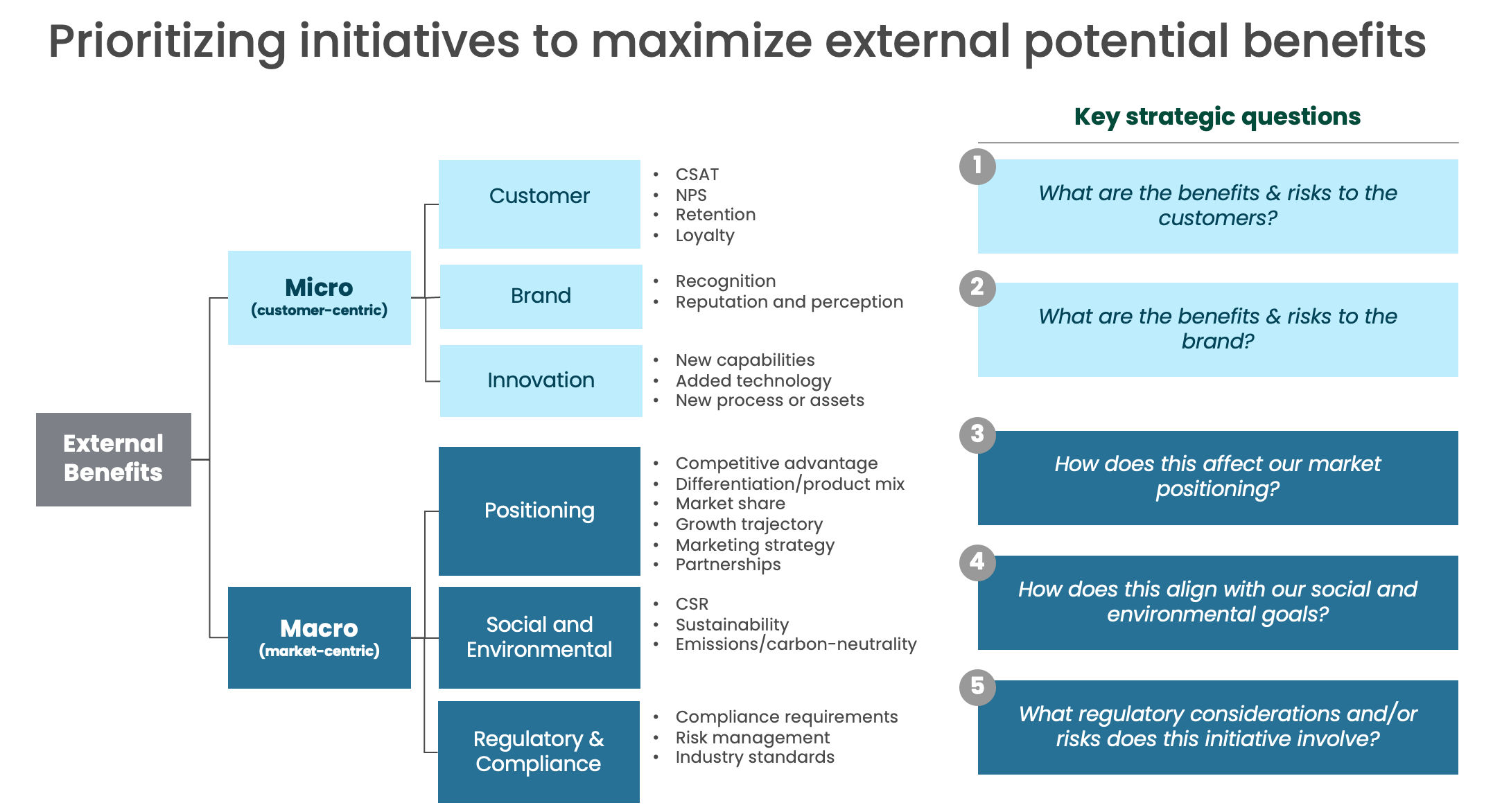
Of course, not all strategic intiatives need to benefit external stakeholders. Initiatives focused on upskilling employees, improving employee satisfaction, and reducing churn can also be critical to the success of certain transformations (e.g., digital transformation, intelligent automation programs).
Leading indicators for initiatives influencing employee satisfaction and culture include:
Employee Engagement Surveys: Regular surveys can measure employee engagement and satisfaction. Positive trends indicate a happier workforce.
Feedback and Idea Generation: Employee-generated ideas and feedback to management are signs of involvement and satisfaction.
Participation in Training & Development Programs: A higher rate of employee participation rate in training and development programs suggests that employees are eager to acquire new skills and grow within the organization.
Peer-to-Peer Recognition: Peer-to-peer recognition and appreciation that happens with some frequency is a signal of a positive, collaborative culture.
Employee Cycle Time: Measures the time elapsed from the initiation of an activity, such as submitting a request or starting a project, to its successful completion or resolution. An enhancement can mean increased autonomy, better collaboration, and time freed for driving other elements of the strategy.
Lagging indicators for initiatives influencing employee satisfaction and culture include:
Employee Retention Rate: Measures the percentage of employees who stay with the organization over a specific period, typically annually. A higher retention rate indicates employees are satisfied and committed to the company.
Employee Satisfaction Surveys: A consistent increase in employee satisfaction scores over a timeframe suggests efficacy in initiatives.
Productivity Metrics: Improvements in individual or team productivity, sales performance, or project completion rates are often the result of a more satisfied and engaged workforce.
Growth in Internal Promotions: Measuring the percentage of promotions filled internally versus externally. A higher percentage of internal promotions suggests that employees are advancing within the organization, which is often tied to job satisfaction.
Exit Interviews and Turnover Reasons: Identifying a decrease in turnover due to dissatisfaction or a shift in reasons can be indicative of improved culture and employee morale.
Once you have the right set of measures for gauging the success of the initiative, the next step is to baseline the current starting point of the metrics that the initiative will impact. A solid baseline will help you set realistic growth targets for your progress.
Next, a forecast for the uplift your initiative will bring to the identified key metrics should be made. Once this is completed, it is time to launch the initiative with leadership support and all the necessary education and communications across the organization.
Keep in mind that this process isn’t always linear; it is very common to move back and forth between steps on the blueprint occasionally, especially if this is your organization’s first major transformation.
Once initiatives have launched and you start to measure their progress, you may find that some initiatives are not on a trajectory to meet your targets. If that’s the case, you may shift resources away from under-performing initiatives to more promising ones.
Making Improvements to Core Capabilities to Accelerate Transformation Success
While prioritization is a make-or-break factor in transformation success, a few other factors are just as influential to the final outcome, including leaders’ visibility into what’s on the roadmap, how resources get allocated to various initiatives, how risks are managed, and the timeliness and quality of communications.
If you want to increase the odds of success, you need to understand your capability gaps and address them. Based on Shibumi’s experience with clients across a variety of industries, here are the make-or-break factors that impact transformation program success:
| Success/Value Driver | Pitfall and why it’s problematic | Ideal state and how it contributes to success |
| Alignment, Focus | Misaligned strategic goals result in execution gaps | Aligning strategic goals with execution leads to better business outcomes |
| Growth, Innovation | Insufficient idea tracking and management is hindering innovation potential and benefit pipeline coverage. | Better management of new ideas and faster evaluation of their potential impact on the business provides greater benefit coverage |
| Speed, Confidence | An inability to evaluate and compare business cases for new initiatives | Ability to quickly and effectively evaluate business cases for new initiatives, resulting in better resource allocation and higher ROI |
| Risk Mitigation | Lack of consistent governance practices across the organization for planning and executing initiatives | Enhanced risk management and improved compliance through consistent governance practices for initiatives |
| Efficiency, Focus | Lack of roadmap visibility is impeding resource allocation and collaboration | The roadmap is transparent and visible to all stakeholders — enabling effective resource allocation and collaboration. |
| Agility | Poor allocation of resources; difficulty in tracking resource utilization | Resource allocation decisions are driven by organizational values and supported by data — resulting in higher productivity. |
| Risk Mitigation, Cost Savings | Poor management of risks, issues and dependencies, leading to delays and cost overruns | Single source of truth for risks, issues and dependencies, which mitigate delays and cost overruns |
| Speed, Growth | An inability to measure and track the benefits and ROI, leading | Clear measurement and tracking of benefits and ROI, leading to better decision-making and greater accountability |
| Speed, efficiency | Reactive decision-making driven by lackluster reporting capabilities and lack of timely data | Stakeholder can access the reports they need in real-time, leading to time saved in reporting process and more reliable decision-making |
| Growth, risk mitigation | Scenario planning and evaluation isn’t done or is done infrequently; leaders do not adequately anticipate risks that result from changes in the business environment. | Value-driven scenario planning is done in a timely manner, which lets leaders respond to changes in the business environment quickly and better manage risks. |
To transform your business successfully, you’ll need to include multiple stakeholders in the planning process. Any transformation blueprint development should include representatives from finance, marketing, IT, and business operations. Involve any department leaders who will be executing specific initiatives and stakeholders who will support the technology and infrastructure needed for these initiatives, too. Every stakeholder can offer valuable insight from their unique area of the business.
Shibumi’s Role in Transformation Success
You also don’t have to create a transformation blueprint and implement it alone. Shibumi’s highly customizable software is designed to help you manage all the steps of a transformation program, from planning to execution management, all the way to benefits reporting. Our work doesn’t stop there—we also provide the methodological expertise and knowledge of best practices that drive lasting, meaningful change with quantifiable ROI.
To find out how Shibumi can accelerate your transformation, request a demo today.
The information in this blog was based on the Shibumi webinar “Set Goals and Build a Success Blueprint for Your Transformation Program.” For more detailed insights into how to create a blueprint for transformation success, watch a replay of the webinar here.