

Even though 91% of enterprises plan to increase their investment in AI this year, its use has been shown to increase levels of burnout among staff, leading to 42% of companies abandoning most AI transformations. This is a huge issue—and one that must be addressed for businesses to succeed in 2026 and beyond.
Savvy leaders are aware that AI fatigue is a strategic problem—not a technology problem. And the solution requires a leadership-driven solution, not an IT one. Addressing the root causes of AI fatigue and its associated ills—things like misalignment and tool proliferation—is the path to competitive advantage and true ROI.
As a strategic execution management business with 15 years of experience bridging the gap between technology and strategic programs, Shibumi has been working with top-performing companies the world over to make their AI programs produce real, measurable results. In this article, we provide a five-phase framework for executives on how to reduce AI fatigue through strategic AI implementation and managing technology complexity. We’ll provide an implementation roadmap, metrics for success to consider, as well as the most common pitfalls to avoid.
Whether you’re a chief strategy officer, digital transformation leader, operations VP, or in a different role where you’re responsible for enterprise technology strategy, we’ll walk you through everything from auditing your current program to advancing your AI strategy.
Why Consolidation, Why Now: From Overwhelm to Strategic Clarity
AI fatigue is not inevitable—it’s a signal that something in the enterprise needs to change. Organizations that adopt a strategic mindset can reduce complexity, restore focus, and unlock the true value of AI platforms. The framework we’ll outline here is not limited by industry or company size; whether scaling enterprise-wide transformation or refining a core set of initiatives, the principles always remain the same—that’s what makes this framework so useful.
The stakes are high. Organizations that master strategic tool selection and consolidation will outperform tool collectors in speed, employee satisfaction, overall execution, and market gains. What sets these winners apart is clear: they treat consolidation as a strategic initiative, invest in adoption and change, establish governance early, and measure what truly matters—outcomes, not just cost.
And in this article, we’re providing you with a proven framework to ensure that your enterprise will be one of the winners.
Keep reading for a breakdown of how to go from overwhelm to clarity through strategic AI tool consolidation.
The Five-Phase Strategic Consolidation Model
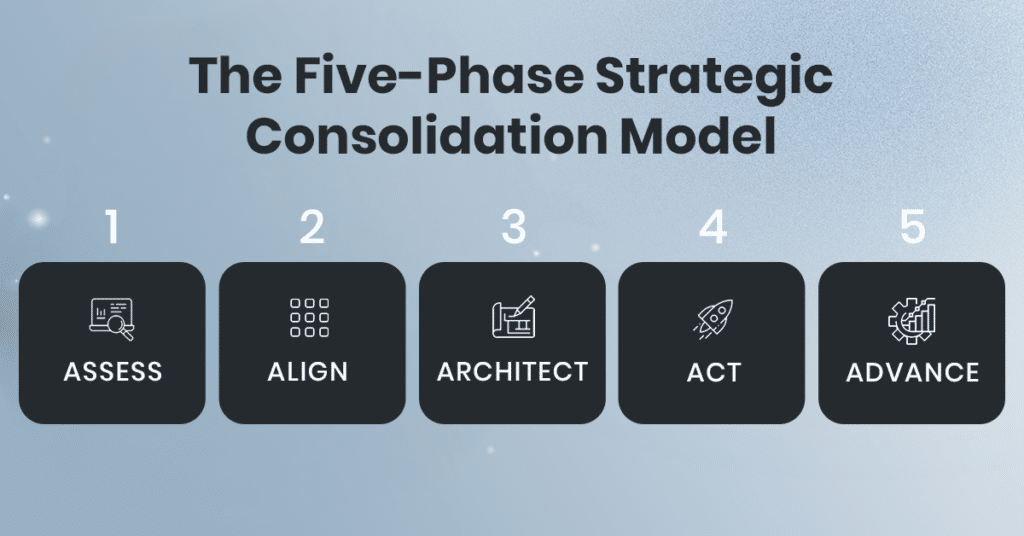
We’ve outlined five phases to reduce AI fatigue in the organization. The at-a-glance phases are:
- Assess: Audit the current state of your AI program and quantify its impact.
- Align: Build stakeholder consensus and vision.
- Architect: Define the target state of the AI program and begin designing a consolidation strategy.
- Act: Execute on consolidation and change management.
- Advance: Optimize current tools, measure the success of AI in the workplace (and adjust as needed), and prevent future sprawl.
Managing technology complexity and reducing AI overwhelm looks different in different organizations, so your timeline will be as unique as your business. Yet, as a general rule of thumb, small and mid-market businesses can expect this process to take 3-4 months, while enterprise-level businesses can expect 6-9 months. Complex and/or global businesses should expect a 9-12 month process.
Success factors include:
✔ Executive sponsorship
✔ Cross-functional team collaboration
✔ Clear governance protocols
✔ Employee buy-in and involvement
✔ Measurement discipline and consistent metric monitoring
Let’s examine each phase in detail, with specific actions you can take—starting today.
Phase 1: Assess—It’s Time to Audit Your Current State
The objective of phase one is to understand the full scope of AI tool proliferation in the enterprise and its impact on your organization before attempting to perform any consolidation or change. Knowing where you stand currently is a vital step toward practical change.
Most executives are surprised by what they find when they conduct a rigorous audit of their AI tool landscape. What starts as a targeted initiative—maybe one tool for a specific department or purpose, another for a different team to experiment with—often balloons into dozens of overlapping subscriptions, redundant capabilities, and shadow IT that no one in leadership ever realized existed.
This is an honest reckoning. The goal isn’t to judge past decisions, it’s to create an accurate picture of the current state—one that gives leadership the necessary evidence to act.
1.1: Conduct a Comprehensive Tool Inventory
The very first step of assessment is to map every AI tool in use across your organization.
What to Do
Create a master list of every AI tool touching your organization—from browser extensions to AI writing tools. For each tool, document the following to the best of your ability:
- Licensing status
- Number of licensed seats versus actual users
- Monthly or annual cost
- Primary use case and owning department
- Redundancies (i.e., where does this tool’s functionality overlap with others?)
How to Do It
A tool inventory is only as good as the thoroughness of the processes used to create it. Try to follow these rules of thumb to ensure completeness:
- Cross-reference your software assessment management systems against current invoices.
- Send a structured questionnaire to every department head, ask about tools they use that are not procured through IT.
- Run a search on expensive reports for common AI vendors and SaaS categories.
- Ask the people doing the work what AI tools they use in their day-to-day work.
Your inventory accuracy target should aim for 95%+ accuracy, accounting for nearly all of the AI tools in active use.
1.2: Measure Utilization and Adoption
Quantify how often your tools are actually being used and by whom.
What to Measure
Licensing a tool and using it are different. Many organizations carry a lot of deadweight in their tech stack—it’s time to get to the bottom of yours.
Measure things like:
- Active users versus licensed seats (AKA the utilization ratio)
- Usage frequency (daily, weekly, monthly, etc)
- Feature adoption within each platform—are users accessing core functionality or only the surface level?
- Time spent per tool
- User satisfaction scores
Where to Get Your Data
- Tool admin dashboards
- IT system logs
- Employee time tracking
- Satisfaction surveys
1.3: Calculate Total Cost of Ownership
Licensing costs are the visible tip of the iceberg, but there is a secret cost to tool proliferation that includes onboarding sessions, productivity drain, and all the time employees spend combating AI fatigue and managing tools. Total cost of ownership analysis includes:
- Licensing fees, implementation costs, and integration development
- IT support, ongoing maintenance, and change management
- Time lost to tool switching, duplicate data entry, and fragmented workflows
- Employee frustration, turnover attributable to AI fatigue, and other morale factors
The MathDirect Costs (licenses, implementation) + Indirect Costs (support, training) + Opportunity Costs (time to value, productivity loss) + Human Costs (turnover, satisfaction impact) = Total Cost of Ownership |
1.4: Identify Pain Points and Impact
It’s time to gather the qualitative evidence that gives your numbers meaning. Qualitative data tells you why the metrics matter—the human stories that make a business case compelling to leadership and boards.
How to Gather It
- Small group sessions (6-8 people) organized by role or department, focused on daily AI workflow friction.
- One-on-one conversations with the team leads to identifying where complexity is blocking execution.
- A concise executive questionnaire on strategic priorities being delayed by tool complexity.
- Where relevant, gather external perspectives on whether AI tool friction is affecting delivery or responsiveness.
Some Key Questions to Answer
- Where is tool complexity blocking strategic work that matters?
- What decisions are delayed or degraded because of AI tool issues?
- How is AI fatigue showing up in team morale, attrition, and performance?
- What opportunities are we missing because our teams are managing tools instead of driving outcomes?
By the end of phase one, you should be able to produce a current state assessment document that includes:
- A complete tool inventory
- Utilization and adoption data broken down by tool and department
- Cost-per-tool and cost-per-user breakdowns
- Qualitative impact analysis with stakeholder quotes and specific examples
- A clear quantified statement of the problem that leadership can act on
Phase one and the documentation produced at the end of it are foundational for the entire process that follows. For leaders serious about reducing AI overwhelm, it is a vital step that grounds the work ahead.
Phase Two: Align—Building Stakeholder Consensus
The objective of phase two is to secure leadership commitment and cross-functional alignment on a consolidation, ensuring that it is the right fit for your organization and that it will have a meaningful impact.
2.1: Build the Business Case
Building the business case is the heart of this work. After all, without a relevant application to the business context, there isn’t a point to following an enterprise AI strategy framework. The key components of building the business case include:
- Problem statement: The current state assessment findings and identified issues within it.
- Financial impact: The total cost of AI tool proliferation.
- Strategic impact: How complexity blocks strategic execution of core functions and long-term objectives.
- Competitive risk: How AI complexity contributes to falling behind the competition.
- Solution vision: Define the target state of AI operations in the business.
- ROI projection: The expected benefits of managing technology complexity and the timeline for consolidation.
- Risk mitigation: The plan to minimize disruption during change.
Data to include in the business case documents might include the amount of spend wasted on unused tools, productivity recapture potential, employee satisfaction improvement projections, and strategic agility gains.
2.2: Identify and Engage Key Stakeholders
Every savvy leader knows that buy-in is crucial for any project to succeed. The engagement process begins by identifying the key people and then the tactics that should be used to encourage and maintain their involvement.
Who Must Be Involved
- An Executive Sponsor: C-suite leader who will own and champion the initiative at the highest levels of the business.
- Steering Committee: A team of cross-functional leaders from across the organization, including representatives from:
- IT
- Finance
- HR/ change management
- Operations
- And relevant business units
- An Implementation Team: Composed of project managers, analysts, and change champions ready to put in the work on the ground to see transformation through.
Stakeholder Mapping
Stakeholder mapping is a visual process of identifying, analyzing, and prioritizing individuals and groups affected by a project or a business initiative. In addition to identifying these individuals, the map can also include:
- Each stakeholder’s influence in the organization and their interest in the project
- Concerns and objections of each stakeholder
- Influence strategies to win their support
- And a communication plan to win and maintain their involvement
Addressing Resistance
Resistance is a normal part of change. Having a prepared response to common objections can help move AI transformations forward, illustrating their unique value.
Leaders may develop and share items such as:
✔ Sunk cost vs. ongoing cost analyses of the current tech stack
✔ Proof of unique benefit
✔ Cost savings possible through consolidation
✔ Cost-benefit analyses of options
2.3: Define Guiding Principles
Now it’s time to define the decision criteria that will guide your program and help you determine which tools are worthy of introducing, keeping, or retiring.
Establish Decision Criteria
The following principles offer a proven foundation for AI tool evaluation.
- Strategic Alignment: Does the tool support core strategic objectives?
- Integration: Does it work with existing systems and/or replace multiple tools?
- Adoption: Is their proven user engagement and satisfaction with the tool?
- ROI: Does the tool produce demonstrable, measurable value?
- Scalability: Can it grow with the organization over time?
Create a Scoring Model
A scoring model works best when it is completed collaboratively—not by a single person with a single objective, but by a cross-functional group from across the organization. Once these individuals are gathered, a scoring model can be created by:
✔ Rating each tool against principles on a 1-5 scale
✔ Weighing principles by importance
✔ Creating objective consolidation prioritization
2.4: Set Vision and Goals
A consolidation effort without a clear vision is just an exercise in cost reduction. Yet, a compelling vision reframes the whole practice, making it about enabling people and meeting big goals—not just cutting tools. This is where you get to dream big, defining what success looks like.
Craft Your Target State Vision
Your vision statement should answer this key question: What does winning look like 12 months from now? It should be ambitious enough to inspire, but specific enough to measure.
Here’s an example of what a good vision statement looks like:
“We will operate with 5-7 strategic AI platforms that cover our core needs, achieving 80%+ adoption, reducing AI-related complexity by 60%, and freeing up 7 hours per employee monthly for strategic work.”
Phase Three: Architect—Design Your Target State
Once phases one and two have been cleared, you can begin creating a detailed consolidation strategy and implementation roadmap aligned to your unique needs and objectives.
3.1: Map Use Cases to Strategic Needs
Connecting use cases to strategic needs can make a material case for some AI tools and clearly highlight the inefficacy of others. Beginning this process requires creating a use case inventory unique to your enterprise.
To do this, begin by listing all business needs currently being addressed by AI tools. From there, organize them into categories (i.e., strategy & planning; data & analytics; communication & collaboration). Once these tools have been organized accordingly, prioritize them on the following scale:
- Critical to operations
- High strategic value
- Medium importance
- Nice to have
- Unnecessary
As you match use cases to their value, always keep this guiding question in mind: “Which use cases directly support our strategic objectives vs. which are tactical conveniences?”
3.2: Evaluate Tool Consolidation Opportunities
Now is the time to really consider how to consolidate AI tools in the enterprise. Below are three consolidation strategies that we’ve found to be effective and repeatable across businesses of different sizes.
Three Consolidation Strategies
Strategy 1: Platform Replacement
Platform replacement is exactly what it sounds like—it means replacing multiple point solutions with an integrated platform(s). This might look like taking five separate tools that perform individual functions with one tool that does all of those and more.
Strategy 2: Feature Consolidation
Feature consolidation is a slightly different approach to managing technology complexity. Instead of replacing multiple tools with one platform, feature consolidation is about leveraging underutilized features in existing tools. For example, you might be paying for analytics abilities that are part of one tool, but employing a whole different tool to do those things, too. This strategy helps leaders identify redundancies and trim tech stack fat.
Strategy 3: Process Redesign
Process redesign is conceptually simple—it simply means eliminating the need for a tool by changing processes so that it becomes obsolete. This requires having a firm understanding of the workflows in place and whether or not a tool is truly unnecessary—so this strategy requires great insight to the work at hand. Yet it is also an opportunity to streamline. For example, leaders might streamline the approval process and thus retire a tool used for that purpose.
Evaluation Criteria
When looking at consolidation strategies, the C-suite should consider the following:
- Will any critical capabilities be lost?
- Does this require any new integrations, and will they be complex?
- What are the data migration requirements?
- Must users be retrained and will that create a burden on the company and its staff?
- What are the cost savings?
- How stable is the vendor and is their tool scalable?
3.3: Design Integration Architecture
Now, it is time to design integration architecture, consider how, among retained tools, data flows are managed, how tools are integrated, and any API connections needed. At this point, it is critical to identify and eliminate any existing silos while being careful not to introduce any new ones.
We suggest a phased approach to redesign that includes:
Quick Wins (Months 1-2)
- Retire obvious redundancies
- Consolidate underutilized tools
- Clean up expired/unused licenses
Medium Complexity (Months 3-6)
- Replace point solutions with platform features
- Migrate data from retiring tools
- Retrain users on consolidated tools
Complex Transformations (Months 6-12):
- Major platform implementations
- Process redesign initiatives
- Cultural change initiatives
Phase Four: ACT—Execute with Excellence
Phase four is the heart of AI fatigue reduction, where action is taken in a thoughtful manner. Thanks to the preparation of phases one, two, and three, leaders can now execute with excellence, consolidating tech with minimal disruption and maximum adoption. Here’s how we breakdown phase four.
4.1: Prepare for Change
Prepare the enterprise for change by creating and implementing a solid change management strategy. This requires a strong communication plan. Communications should explain the following:
- Why we’re consolidating, clearly stating the benefits to constituents.
- What’s changing, laying out the specifics.
- A clear timeline of change.
- How they can get support at any point in the process.
- And who to contact with questions.
These messages should reach executives monthly, teams bi-weekly, and individuals as changes affect them. They should also be multichannel—delivered at in-person meetings, via email, other digital channels, and in one-on-one manager conversations.
4.2: Train and Enable Users
Empower users with a tiered training methodology based on individuals’ roles. This looks like:
- Power users: These users receive extensive training and become internal champions
- Regular users: Regular users receive training on essential features and practical workflow guidance.
- Occasional users: As-needed resources and basic training.
At this point, a support structure should also be put in place and include a dedicated support channel via Slack and/or email; IT help desk escalation processes; and vendor supported resources.
4.3: Migrate Data and Sunset Tools
Now it’s time to consolidate and migrate to finally manage technology complexity in the workplace. Here’s the process broken down into three steps:
Pre-Migration:
- Data audit and cleanup
- Migration testing in sandbox
- Rollback plan documented
- Users notified with specific timeline
During Migration:
- Execute during low-usage periods
- Monitor migration in real-time
- Maintain parallel access during transition
- Immediate support available
Post-Migration:
- Validation that data transferred correctly
- User acceptance testing
- Archive old system (don’t delete immediately)
- Decommission after stability period (30-90 days)
4.4: Monitor Adoption and Iterate
Congratulations! A lot of the hard work is done! Now it is time to track the success of the work you’ve done so far to reduce AI fatigue for your team.
Adoption Metrics to Track
Gauging success requires measuring clear indicators of it. Here’s what we suggest tracking:
Quantitative:
- Login frequency
- Feature usage
- Active users vs. licensed
- Time spent in tool
- Tasks completed
Qualitative:
- User satisfaction surveys
- Help desk ticket volume
- Champion feedback
- Manager reports
The Iteration Process
Review these metrics during the first 30 days and biweekly after that, when things have stabilized. Adjust training, support, and features based on feedback. Along the way, look out for declining usage after initial spikes, workarounds being created, and old tool usage.
Phase Five: ADVANCE—Optimize and Prevent Future Sprawl
The objective of phase five, the final phase in the AI fatigue reduction framework, is to lock in gains, optimize usage, and establish governance to prevent regression in the future.
5.1: Establish Ongoing Governance
It is critical at this stage to apply an ongoing governance protocol to promote strategic alignment and reduce future sprawl.
A basic AI tool governance framework includes the following elements:
- A Governance Committee: To meet quarterly, review tool performance, approve new tool requests, and enforce governance policies.
- A New Tool Approval Process: Which should include the business case, evaluation against existing tools, integration assessments, budget requirements, and a pilot before rollout.
- A Clear Approval Criteria: Which includes its strategic necessity, ROI projection, integration feasibility, and a roadmap to user adoption.
5.2: Measure and Optimize ROI
Again, this step requires having clear, trackable metrics to gauge success. We recommend tracking the following:
Financial Metrics to Track :
- Total AI tool spend vs. baseline
- Cost per active user
- Savings realized from consolidation
- Avoided costs from prevented sprawl
Productivity Metrics to Track:
- Hours reclaimed per employee
- Decision cycle time
- Strategic initiative velocity
- Meeting time on tools vs. strategy
Satisfaction Metrics to Track:
- Employee approval of tools
- Tool-related turnover
- Help desk ticket volume
- Adoption rates
5.3: Optimize Tool Usage
Maximizing value from retained and newly integrated tools requires identifying underutilized, but valuable features and creating example use cases, additional training, and incentivized exploration of those aspects.
At this stage, leaders should look to automate repetitive processes, improve data flow, and reduce manual handoffs while looking to users for feedback to improve any aspects of the platforms possible. Leaders can also work with vendors to improve customization, streamline interfaces, and remove any friction points.
| Your AI Fatigue and Tech Consolidation Checklist Ready to Get Started? Follow This Sequence: Week 1-2: Prepare
Week 3-6: Assess
Week 7-8: Align
Week 9-12: Architect
Week 13+: Act
Ongoing: Advance
Download the Checklist |
You Don’t Have to Do It Alone: Consolidate with Shibumi
Success in consolidation requires more than narrowing down your stack to the right tools. Change management must be treated as equally critical, ensuring employees are supported and equipped to succeed. At the same time, strong governance prevents regression into tool sprawl, protecting both your investment and your people from returning to a state of AI overwhelm. Using a platform to track and manage all initiatives and their progress in one place can be a huge help.
Shibumi is here to help at every phase of the process.
Shibumi allows enterprises to move from tool complexity to strategic focus—consolidating strategy management, portfolio optimization, and performance tracking into a single, integrated system. Just one source of truth, one platform to manage, one intuitive interface.
Ready to see how Shibumi enables consolidation? Schedule a free, no-commitment demo.