

To maximize profit margins and market competitiveness, enterprises must scale. Yet, as they do, their rosters of participants grow while their projects become increasingly complex. This creates inevitable growing pains: IT teams are strained as they manage more administrative tasks, such as granting and revoking system access. Bottlenecks emerge as teams try to maintain compliance and security while managing new users and privileges. And then, operational efficiency begins to lag, undermining the entire purpose of scaling in the first place.Many portfolio management approaches break down as complexity increases. Expanding the number of concurrent projects, however, is necessary to achieve ambitious business goals. Without the ability to scale access, projects, and users, an enterprise simply can’t grow. Yet, many strategic portfolio management (SPM) software programs aren’t able to meet the demands of growing businesses, particularly in one of the most important but overlooked areas: access management.
Access management is easy to ignore, but across hundreds of enterprises, we’ve seen the same recurrent theme: Scalable access management is a requirement in the modern business world, not a nice-to-have.
At Shibumi, we’ve made it our mission to understand what high-growth enterprises need to progress and expand. The ability to define custom User Groups and to assign them to program roles makes access management faster, smarter, and capable of keeping pace as your organization, and its portfolio of strategic programs, grows.
With effective access management in custom user groups, organizations can keep their teams focused on execution, maintain governance, and reduce administrative burden.
Why Scalable Access Management Is a Must
As they grow, companies need to add new access points, projects, and users to their SPM solutions. Access management is frequently neglected in the rush to integrate new tools, software, projects, and team members, which can harm the business and its overarching plans.
Lack of proper access management creates hurdles in both the short and long term, including:
- Execution Bottlenecks: Poor scalability in access control means IT teams often spend excessive hours manually provisioning and auditing user permissions. This is an inefficient use of skilled resources and creates the potential for friction, error, and “shadow IT,” where disconnected business units use unauthorized workarounds.
- Compromised Security: Robust access controls prevent unauthorized users from accessing sensitive information. Simultaneously, it ensures that users with the relevant credentials never struggle to access the information they need to do their jobs. Without efficient access controls, security suffers.
- Operational Delays: SPM solutions rely on accurate, centralized data to align strategic goals to capacity and other aspects of operations. With clunky, spotty access management, it becomes difficult to see, update, and act on current data.
- Strategic Misalignment: The gap between business strategy and execution grows when SPMs struggle with identity and access management. As permissions and data lag, visibility suffers, impacting the ability to align tasks to daily operations and long-term goals. Over the course of months and years, this process slows growth and impedes innovation.
The risks we’ve outlined above can cripple the efficient execution of programs run by enterprises in highly competitive environments, which is why savvy leaders are prioritizing effective, scalable access controls in their SPM solutions.
What Dynamic, Effective Access Management Looks Like
When your portfolio management solution connects strategy to delivery, plans for people alongside budgets, and adapts to organizational change, scaling access controls in lockstep becomes an easy strategic advantage rather than an administrative burden. Here’s what it looks like in practice.
Instant Access through Group Membership
Speed is important to everyone. With the right SPM solution, speed and effective access control aren’t an either-or choice. Shibumi’s User Groups feature accelerates the access control process by granting instant access to anyone assigned to a specific group with no administrative lag. Onboarding is seamless, not messy or confusing.
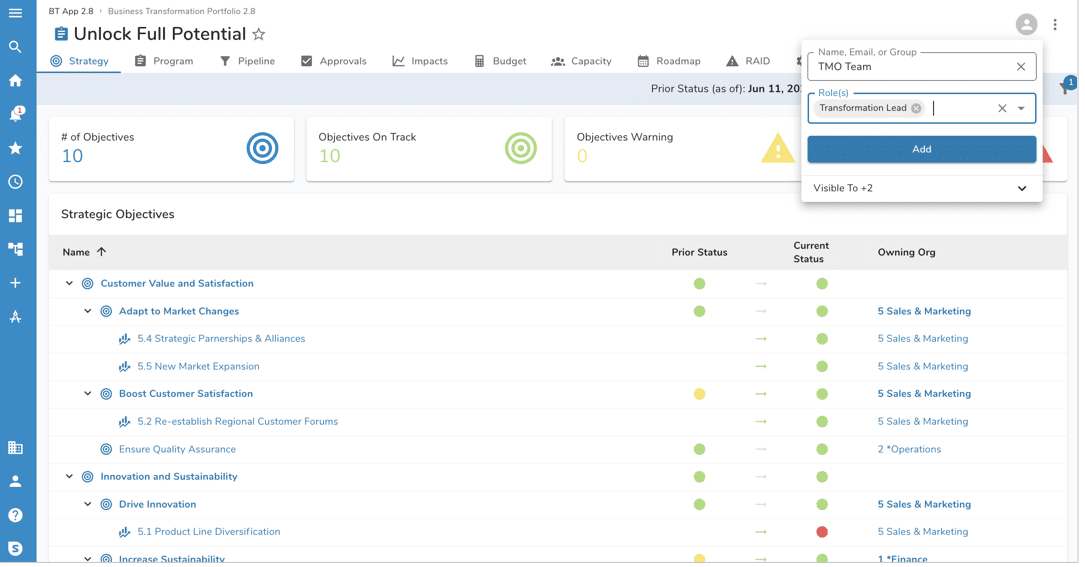
The first step is to define the group and assign membership. Groups can be based on data sensitivity level, specific job functions, or contextual characteristics like department or region. Once the group is defined, it can be assigned a role on a program work item in the same way you would have previously assigned an individual user to that role. The role determines the access permissions granted to the group’s members. As users are added to or removed from the group, their access is immediately adjusted. The management of membership in the group is a security hallmark in dynamic access control, as it allows administrators to provision or revoke access quickly without configuring permissions for individual users.
Automation Based on Business Rules
Once groups are created based on roles and attributes, they can then be paired with other features to automate access levels in a robust SPM solution like Shibumi’s. Our platform links our User Groups function to our business rules engine to ensure the right people are always in the right seats, with the right permissions and zero manual steps in between. This effectively reduces administrative burden while the company scales without sacrificing security.
Drift Detection and Access Auditing
Dynamic, effective access controls prevent entitlement drift—when permissions differ from what users actually need— and unauthorized modifications to data sets and other resources. Drift detection and access auditing preserve the single source of truth created by the SPM solution and identify accounts or inherited roles with elevated privileges that aren’t necessary.
Together, these two elements help maintain visibility, governance, and security.
Unlock More Potential in Your SPM with Shibumi’s Access Control Capabilities and New Custom User Groups
High-growth enterprises understand the value of collaboration. Yet, collaboration at scale can create difficulties, such as maintaining security while onboarding new users or sharing data.
At Shibumi, we have developed our business by listening to the needs of high-performing enterprises and providing a solution that does everything they need and nothing they don’t. Our access control capabilities are granular enough to safeguard the most sensitive data and include automations that help growing businesses maintain their pace. The end result? Users can securely get the information they need to collaborate effectively, and the business never misses a beat.
User Groups is the newest addition to our suite of access control tools. Administrators can define custom groups (e.g., “program executives” or “finance reviewers”) that are aligned with the way the organization actually works.
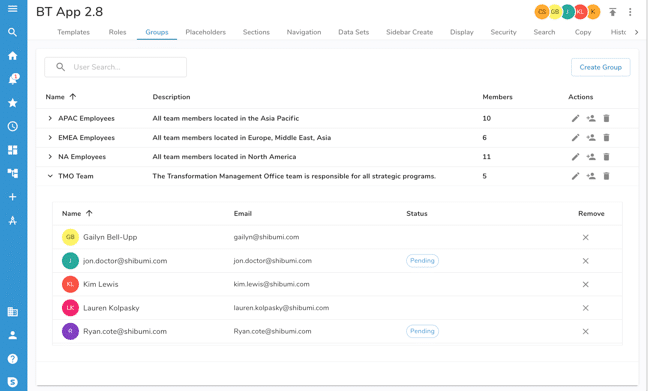
User Groups is flexible enough to quickly provision users, yet it never compromises security or visibility. When group assignment to roles occurs using our Business Rules engine, the process is even smoother.
Everything we do at Shibumi is designed to support our customers as they work towards their big goals and grow their businesses. We are delighted to minimize administrative burden and to streamline access management with the introduction of custom User Groups.
Want to learn more about Shibumi’s work with high-growth enterprises or how your company can deploy User Groups? Schedule a call with one of our experts.